
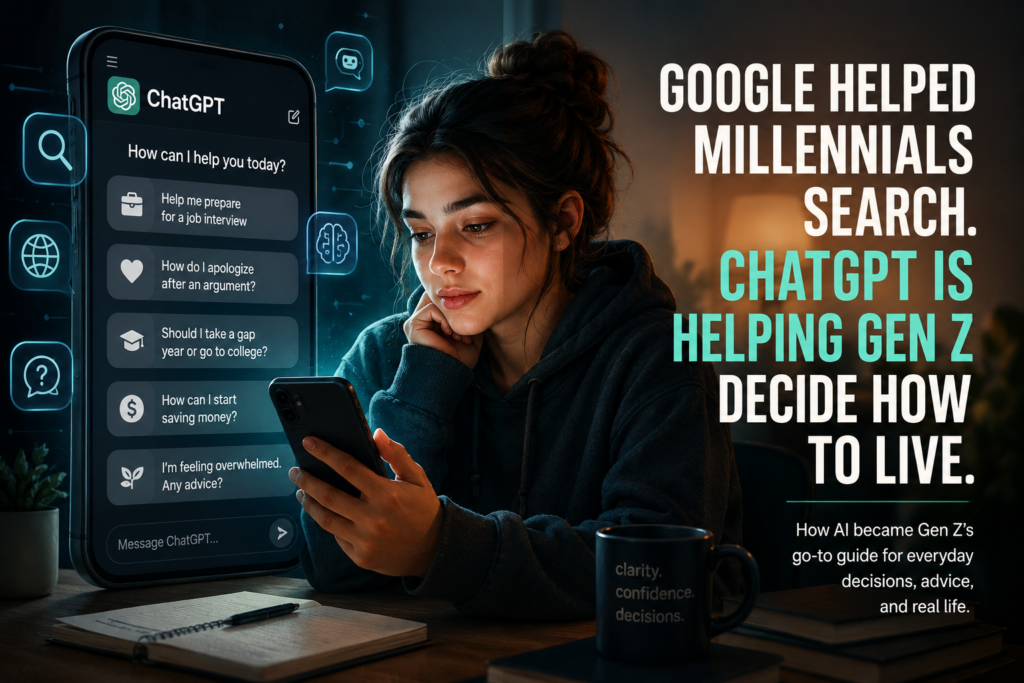


A growing number of young Americans no longer open Google first when they feel uncertain. They open ChatGPT.
Before sending a risky text, preparing for a job interview, choosing a college major, or even figuring out how to respond during an argument, many Gen Z users are now consulting artificial intelligence as naturally as previous generations asked friends or searched forums. What sounded futuristic just a few years ago has quickly become part of everyday life.
That shift exploded into public conversation after OpenAI CEO Sam Altman commented on how differently Gen Z uses AI compared to older generations. According to Altman, many young users treat ChatGPT almost like an “operating system” for daily decision-making. The statement resonated because it captured something millions of people were already quietly noticing.
This transformation is no longer limited to productivity tools or homework assistance. The growing reliance on ChatGPT among Gen Z users reflects changing ideas around trust, identity, emotional connection, and the evolving relationship between humans and technology.
Why Gen Z Is Using ChatGPT Differently
AI Feels Faster, Safer, and Less Judgmental
For many Gen Z users, ChatGPT offers something the internet often doesn’t: calm, personalized responses without social pressure. Traditional search engines throw users into a sea of links, ads, Reddit arguments, and conflicting opinions. AI feels cleaner and more conversational.
Instead of typing:
- “best resume tips”
- “how to apologize after an argument”
- “how to negotiate salary”
Young users can simply explain their situation naturally and receive an instant tailored response.
That experience feels human in a way search engines never did.
Many Gen Z adults also grew up during periods of economic uncertainty, social media pressure, student debt anxiety, and constant digital overload. As a result, they value tools that reduce stress and simplify decision-making. ChatGPT delivers exactly that.
The appeal becomes even stronger because AI never appears impatient or dismissive. People can ask embarrassing, repetitive, emotional, or deeply personal questions without fear of judgment.
For a generation already comfortable living digitally, AI advice feels surprisingly normal.
The Rise of AI as a Daily Life Assistant
From Career Choices to Relationship Advice

One of the biggest reasons this trend is accelerating is because ChatGPT is no longer used only for technical tasks. It now supports everyday decision-making across nearly every part of life.
Common Ways Gen Z Uses ChatGPT
| Situation | How AI Is Used |
|---|---|
| Job hunting | Resume editing, interview prep |
| Relationships | Text drafting, communication advice |
| Money management | Budget planning, saving strategies |
| Education | Study help, essay structure |
| Mental wellness | Journaling prompts, emotional reflection |
| Productivity | Scheduling, habit tracking |
In the U.S., younger professionals are increasingly using AI during workdays to summarize meetings, organize projects, draft emails, and improve efficiency. College students use it for brainstorming, studying, and simplifying complex topics.
But the emotional side of AI usage is what surprises many experts most.
Some users describe ChatGPT as:
- A thinking partner
- A personal coach
- A brainstorming companion
- A nonjudgmental listener
That doesn’t necessarily mean people believe AI is conscious. Instead, they value the consistency and accessibility it provides.
At 2 a.m., ChatGPT answers immediately. Most humans don’t.
Why Gen Z Trusts AI More Than Traditional Sources
The Collapse of Information Trust

Gen Z grew up online during an era filled with:
- Clickbait headlines
- Misinformation
- Polarized social media
- Influencer marketing
- Algorithm manipulation
As a result, younger users often approach traditional information systems with skepticism.
Ironically, conversational AI can feel more transparent than scrolling through pages of sponsored search results.
When ChatGPT explains something directly in plain language, users feel like they’re getting clarity instead of competing agendas. Whether that perception is fully accurate is another debate entirely, but emotionally, the experience feels trustworthy.
There’s also a psychological reason behind this shift.
Human advice is messy. Friends project their own experiences. Family members bring emotional bias. Online comments are chaotic. AI responses feel structured, neutral, and instantly adaptable.
That creates a powerful illusion of objectivity.
According to surveys from U.S. workplace studies in 2024 and 2025, younger employees are also adopting AI tools faster than older generations for daily productivity tasks. Many already view AI assistance not as optional, but as a competitive advantage.
To Gen Z, using ChatGPT can feel less like cheating and more like upgrading.
Is ChatGPT Becoming an Emotional Support Tool?
The Loneliness Factor Nobody Talks About Enough
One reason this trend is spreading so quickly has little to do with technology itself.
It has to do with loneliness.
The U.S. Surgeon General has repeatedly warned about rising loneliness and social isolation among younger Americans. Many Gen Z adults report feeling disconnected despite spending enormous amounts of time online.
AI enters that emotional gap in a surprisingly effective way.
Unlike social media:
- AI doesn’t compare lifestyles
- AI doesn’t publicly shame users
- AI doesn’t ignore messages
- AI doesn’t create social competition
Instead, it responds instantly and attentively.
That emotional consistency matters more than many people realize.
Some mental health experts believe conversational AI can offer helpful reflection tools, journaling support, and emotional organization. Others worry that excessive reliance on AI could weaken real-world social skills or encourage emotional dependency.
Both perspectives may be true simultaneously.
AI can help people feel supported while also potentially reducing human-to-human interaction if overused.
That tension sits at the center of the modern AI debate.
The Productivity Generation Powered by AI
Gen Z Sees AI as a Survival Tool
Previous generations often treated new technology as optional convenience. Gen Z increasingly sees AI as necessary infrastructure.
Why?
Because modern life feels overwhelming.
Young Americans face:
- Rising housing costs
- Student debt
- Competitive job markets
- Economic uncertainty
- Burnout culture
- Constant digital expectations
AI helps compress time and reduce mental friction.
Instead of spending three hours researching a topic, users can get summarized guidance within seconds. Instead of struggling alone with planning or writing tasks, AI can organize information instantly.
That creates an enormous psychological reward.
Key Benefits Gen Z Associates With ChatGPT
- Faster decisions
- Reduced stress
- Increased productivity
- Better communication
- Personalized learning
- Easier organization
For digital-native generations, using AI feels similar to using calculators, GPS navigation, or smartphones. It quickly stops feeling revolutionary and starts feeling normal.
That normalization is happening much faster than many experts predicted.
The Risks of Relying Too Much on AI
Convenience Can Quiet Critical Thinking
Even enthusiastic AI supporters acknowledge growing concerns about overdependence.
When people constantly outsource:
- brainstorming,
- emotional processing,
- decision-making,
- writing,
- and problem-solving,
they may gradually weaken independent thinking skills.
This concern becomes especially important for younger users whose identities and cognitive habits are still developing.
AI systems can also:
- Hallucinate incorrect information
- Reinforce user biases
- Provide oversimplified answers
- Sound confident while being wrong
Because conversational AI sounds polished and authoritative, users may trust responses too easily.
That’s where digital literacy becomes critical.
Experts increasingly recommend treating AI as:
- a co-pilot,
- not an autopilot.
The healthiest use cases involve collaboration rather than blind dependence.
For example:
- Using ChatGPT to brainstorm interview answers is useful.
- Letting AI completely define life decisions without personal reflection is riskier.
The difference matters.
How Businesses and Brands Are Reacting
The Marketing Shift Toward AI-Native Audiences
Brands are already adapting to the reality that Gen Z increasingly interacts with information conversationally instead of traditionally.
This changes everything about:
- SEO
- advertising
- education
- customer support
- content creation
Companies now optimize content not only for Google search but also for AI-generated summaries and conversational discovery tools.
The rise of ChatGPT has accelerated discussions around:
- AI search optimization
- conversational commerce
- AI assistants replacing browsers
- personalized digital experiences
For businesses targeting younger audiences, understanding AI behavior is becoming essential.
If Gen Z asks ChatGPT for:
- product recommendations,
- travel ideas,
- budgeting tools,
- skincare advice,
- or career guidance,
then brands must learn how to appear inside AI-driven conversations.
That may become one of the biggest digital marketing transformations of the next decade.
What This Means for the Future of Human Decision-Making
AI Is Becoming Infrastructure, Not Just Software
Sam Altman’s comments struck a nerve because they revealed something much larger than a passing trend.
AI is quietly moving from:
- tool
to - companion infrastructure.
For Gen Z, ChatGPT is not simply an app. It increasingly functions as:
- a tutor,
- assistant,
- planner,
- editor,
- strategist,
- sounding board,
- and information filter.
That doesn’t mean human relationships disappear. But it does mean the role technology plays in personal thinking is changing dramatically.
Future generations may grow up assuming AI collaboration is a normal part of:
- education,
- career planning,
- emotional support,
- and everyday decision-making.
The real question is no longer whether AI will influence society.
It already does.
The deeper question is how humans maintain critical thinking, emotional intelligence, and authentic connection while integrating AI into daily life.
That balance may define the next decade.
Key Takeaways
- Gen Z using ChatGPT is becoming a major cultural and technological trend.
- Young Americans increasingly use AI for career, relationship, productivity, and emotional support decisions.
- ChatGPT feels faster, more personalized, and less judgmental than traditional search engines.
- AI adoption is accelerating because Gen Z views it as a practical survival and productivity tool.
- Experts warn against overreliance and encourage using AI as a collaborative assistant rather than a replacement for independent thinking.
Pros and Cons of Gen Z Using ChatGPT
| Pros | Cons |
|---|---|
| Instant guidance | Risk of overdependence |
| Increased productivity | Potential misinformation |
| Emotional accessibility | Reduced critical thinking |
| Personalized responses | Privacy concerns |
| Better organization | Less human interaction |
Common Mistakes to Avoid When Using AI for Decisions
1. Treating AI Answers as Absolute Truth
AI can sound confident even when incorrect.
2. Replacing Human Relationships Entirely
Technology should support communication, not eliminate it.
3. Ignoring Privacy Concerns
Sensitive personal information should always be shared carefully.
4. Losing Independent Thinking Skills
Use AI to enhance thinking, not replace it.